

68 Circular Road, #02-01 049422, Singapore
Revenue Tower, Scbd, Jakarta 12190, Indonesia
4th Floor, Pinnacle Business Park, Andheri East, Mumbai, 400093
Cinnabar Hills, Embassy Golf Links Business Park, Bengaluru, Karnataka 560071


Connect With Us



68 Circular Road, #02-01 049422, Singapore
Revenue Tower, Scbd, Jakarta 12190, Indonesia
4th Floor, Pinnacle Business Park, Andheri East, Mumbai, 400093
Cinnabar Hills, Embassy Golf Links Business Park, Bengaluru, Karnataka 560071
Connect With Us
68 Circular Road, #02-01 049422, Singapore
Revenue Tower, Scbd, Jakarta 12190, Indonesia
4th Floor, Pinnacle Business Park, Andheri East, Mumbai, 400093
Cinnabar Hills, Embassy Golf Links Business Park, Bengaluru, Karnataka 560071
Request Custom Transcript
USA AI in Industrial Automation Market (2026–2031): Forecasting from ~USD 5.2 Billion in 2025 to ~USD 20.5 Billion by 2031, CAGR (~26.1%) | Machine Learning, Robotics, Predictive Maintenance, Process Control Systems”
The USA AI in industrial automation market is expected to grow substantially from USD 5.2 billion in 2025 to USD 20.5 billion by 2031, registering a CAGR of 26.1%. Key growth drivers include the increased integration of AI technologies like machine learning, robotics, predictive maintenance, and process control systems in manufacturing sectors such as automotive, electronics, oil & gas, and consumer goods. AI solutions enable companies to improve production efficiency, quality control, supply chain optimization, and energy management. The adoption of autonomous robots and smart sensors is becoming critical to meet demands for real-time monitoring and predictive analytics. Edge computing and cloud AI systems are enhancing operational visibility and decision-making. As U.S. manufacturers focus on Industry 4.0 and digital transformation, AI technologies are being deployed for advanced automation, reducing operational costs, and improving sustainability. The market’s rapid expansion is also supported by strong government incentives and the ongoing evolution of smart factories and intelligent manufacturing systems.
.avif)
What's Covered?
Report Summary
Key Takeaways
- Market expected to grow from USD 5.2B (2025) to USD 20.5B (2031) at a 26.1% CAGR.
- Machine learning and predictive maintenance are expected to drive 50% of market growth.
- Robotics integration will represent 30% of market share by 2030.
- Process control systems and automated manufacturing contributing 20% to the total market value.
- AI in manufacturing improving productivity by 25% and quality control by 30%.
- The automotive sector remains the largest adopter, representing 40% of market demand.
- Energy management solutions are expected to save manufacturers 15–20% on energy costs.
- Predictive analytics will reduce unplanned downtime by 35% in manufacturing plants.
- Edge computing solutions improving data processing speeds and real-time decision-making.
- U.S. government incentives for smart manufacturing accelerating the transition to AI-powered automation.
Market Size & Share
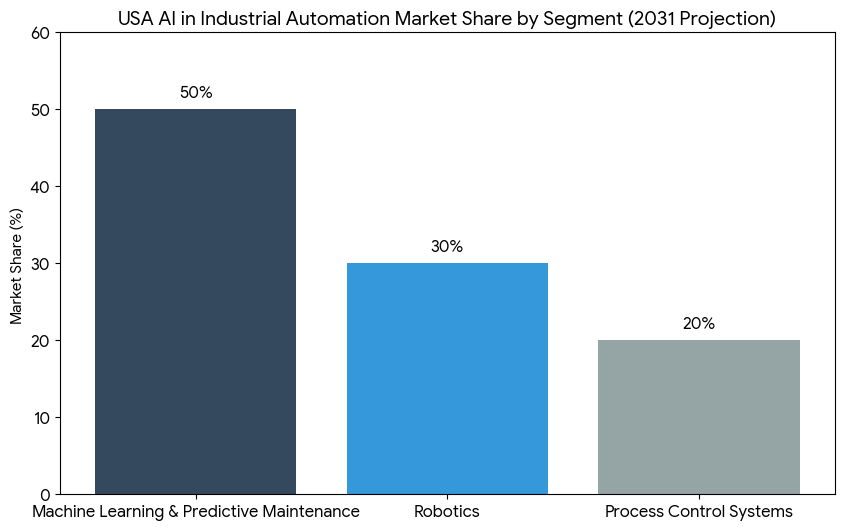
The USA AI in industrial automation market is set to reach USD 20.5 billion by 2031, expanding at a 26.1% CAGR. Machine learning and predictive maintenance will drive 50% of market growth as manufacturers seek ways to optimize production and minimize downtime. The robotics segment is projected to capture 30% of market share, with autonomous robots enhancing assembly line efficiency and warehousing operations. Process control systems will also account for 20% of the market as companies adopt AI-driven control systems for improved decision-making and energy management. With strong government support and the ongoing trend of smart factories, North America is set to lead the way in industrial AI adoption.
Market Analysis
The integration of AI technologies such as machine learning, robotics, and predictive maintenance is accelerating the U.S. industrial automation market. Machine learning algorithms are enabling real-time decision-making for process optimization and demand forecasting. Robotics is playing a crucial role in manufacturing lines, enabling autonomous assembly and inspection. Additionally, predictive maintenance systems powered by AI and IoT sensors are minimizing unplanned downtime by detecting potential failures before they occur. Companies are increasingly investing in smart factories, leveraging AI-driven software platforms and automated systems to improve operational efficiency, reduce energy costs, and optimize labor allocation. Edge computing is enhancing data processing capabilities, enabling faster responses and reducing reliance on centralized servers.
Trends & Insights
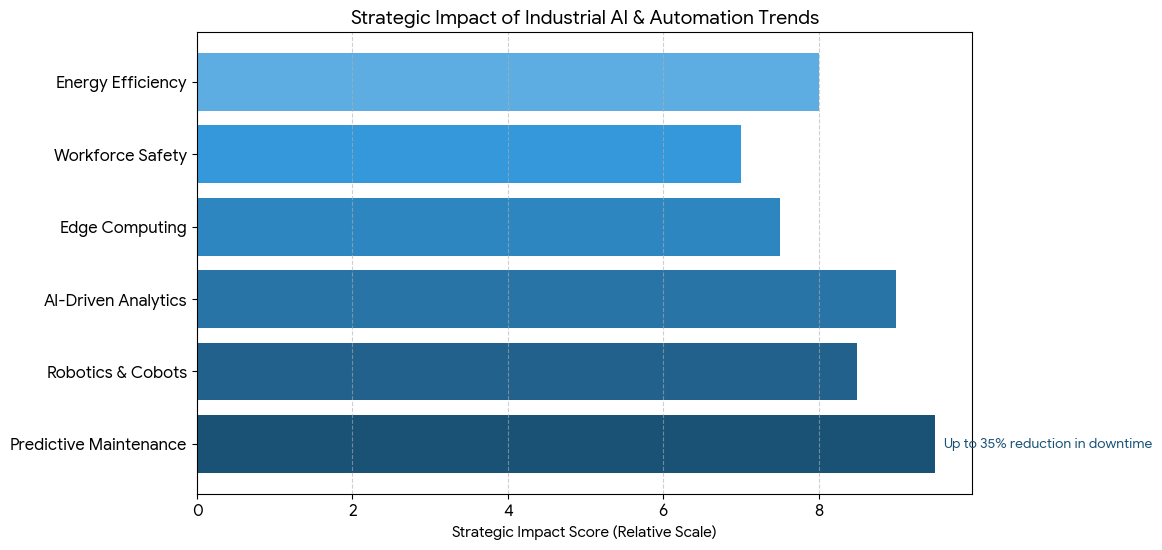
- AI-Driven Process Optimization: Machine learning algorithms improving production speed and efficiency.
- Predictive Maintenance: Reducing unplanned downtime by up to 35% and increasing asset lifespan.
- Robotics Adoption: Rapid growth in collaborative robots (cobots) and automated forklifts for flexible manufacturing.
- AI-Powered Analytics: Enabling real-time data processing and decision-making in manufacturing.
- Edge Computing: Reducing latency and enabling local decision-making on the factory floor.
- Energy-Efficient Solutions: AI optimization reducing energy consumption in production facilities.
- Supply Chain Automation: AI-powered supply chain solutions optimizing logistics and inventory management.
- Sustainability: Increasing focus on green technologies and energy-efficient industrial automation solutions.
- Industrial IoT: Growing adoption of connected devices and sensors in production environments.
- AI in Workforce Safety: Machine learning enhancing worker safety by predicting potential accidents.
Segment Analysis
By technology, machine learning and predictive maintenance lead, accounting for 50% of the market. These technologies help companies optimize production efficiency and minimize downtime. Robotics accounts for 30% of the market, playing a significant role in automated manufacturing and warehouse operations. Process control systems (PCS) hold 20% of the market as businesses increasingly implement AI-based PCS for better quality control and supply chain management. The robotics segment continues to expand, driven by autonomous systems used in assembly lines, inspections, and handling materials. AI-driven data analytics and cloud-based solutions are revolutionizing how manufacturers handle predictive analytics, quality control, and logistics management.
Geography Analysis
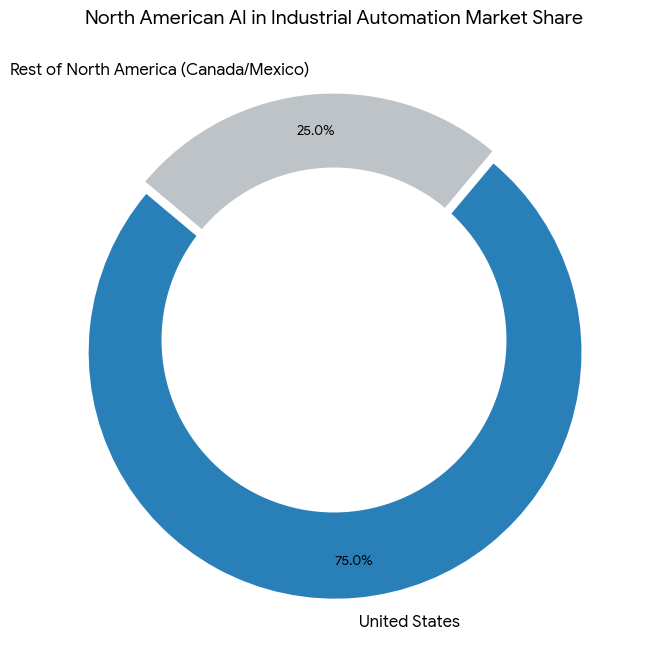
The United States leads the market, accounting for over 75% of the total North American market. Key states such as California, Texas, and Michigan are seeing rapid adoption of AI-driven automation solutions due to their strong manufacturing sectors and significant investment in AI and robotics. California is particularly driving robotics and AI-based manufacturing solutions due to its focus on sustainability and energy-efficient automation. Michigan and Ohio are major centers for automotive manufacturing, where AI-powered robotics and process optimization are transforming assembly lines. Canada is also experiencing rapid growth in AI manufacturing adoption, driven by the government’s focus on advanced manufacturing and smart factory technologies.
Competitive Landscape
Leading companies in the USA AI in industrial automation market include Siemens, Rockwell Automation, ABB, Fanuc, KUKA, Caterpillar, Honeywell, and GE Automation. Siemens and Rockwell Automation are leaders in AI-powered process control systems and factory automation software, while Fanuc and KUKA dominate the robotics segment, offering a wide range of industrial robots for automotive, electronics, and food processing industries. Honeywell focuses on IoT-based predictive maintenance and energy-efficient solutions, while GE Automation leverages AI for industrial Internet of Things (IIoT) applications. These companies are continuously developing AI and machine learning platforms to enhance real-time data processing, predictive analytics, and robotic systems in smart factories.
Report Details
Proceed To Buy
Want a More Customized Experience?
- Request a Customized Transcript: Submit your own questions or specify changes. We’ll conduct a new call with the industry expert, covering both the original and your additional questions. You’ll receive an updated report for a small fee over the standard price.
- Request a Direct Call with the Expert: If you prefer a live conversation, we can facilitate a call between you and the expert. After the call, you’ll get the full recording, a verbatim transcript, and continued platform access to query the content and more.
68 Circular Road, #02-01 049422, Singapore
Revenue Tower, Scbd, Jakarta 12190, Indonesia
4th Floor, Pinnacle Business Park, Andheri East, Mumbai, 400093
Cinnabar Hills, Embassy Golf Links Business Park, Bengaluru, Karnataka 560071
Request Custom Transcript
Related Transcripts


68 Circular Road, #02-01 049422, Singapore
Revenue Tower, Scbd, No.52-53, Jakarta 12190, Indonesia
Cinnabar Hills, Embassy Golf Links Business Park, Bengaluru, Karnataka 560071
4th Floor, Pinnacle Business Park, Andheri East, Mumbai, 400093


68 Circular Road, #02-01 049422, Singapore
Revenue Tower, Scbd, Jakarta 12190, Indonesia
4th Floor, Pinnacle Business Park, Andheri East, Mumbai, 400093
Cinnabar Hills, Embassy Golf Links Business Park, Bengaluru, Karnataka 560071