

68 Circular Road, #02-01 049422, Singapore
Revenue Tower, Scbd, Jakarta 12190, Indonesia
4th Floor, Pinnacle Business Park, Andheri East, Mumbai, 400093
Cinnabar Hills, Embassy Golf Links Business Park, Bengaluru, Karnataka 560071


Connect With Us



68 Circular Road, #02-01 049422, Singapore
Revenue Tower, Scbd, Jakarta 12190, Indonesia
4th Floor, Pinnacle Business Park, Andheri East, Mumbai, 400093
Cinnabar Hills, Embassy Golf Links Business Park, Bengaluru, Karnataka 560071
Connect With Us
68 Circular Road, #02-01 049422, Singapore
Revenue Tower, Scbd, Jakarta 12190, Indonesia
4th Floor, Pinnacle Business Park, Andheri East, Mumbai, 400093
Cinnabar Hills, Embassy Golf Links Business Park, Bengaluru, Karnataka 560071
Request Custom Transcript
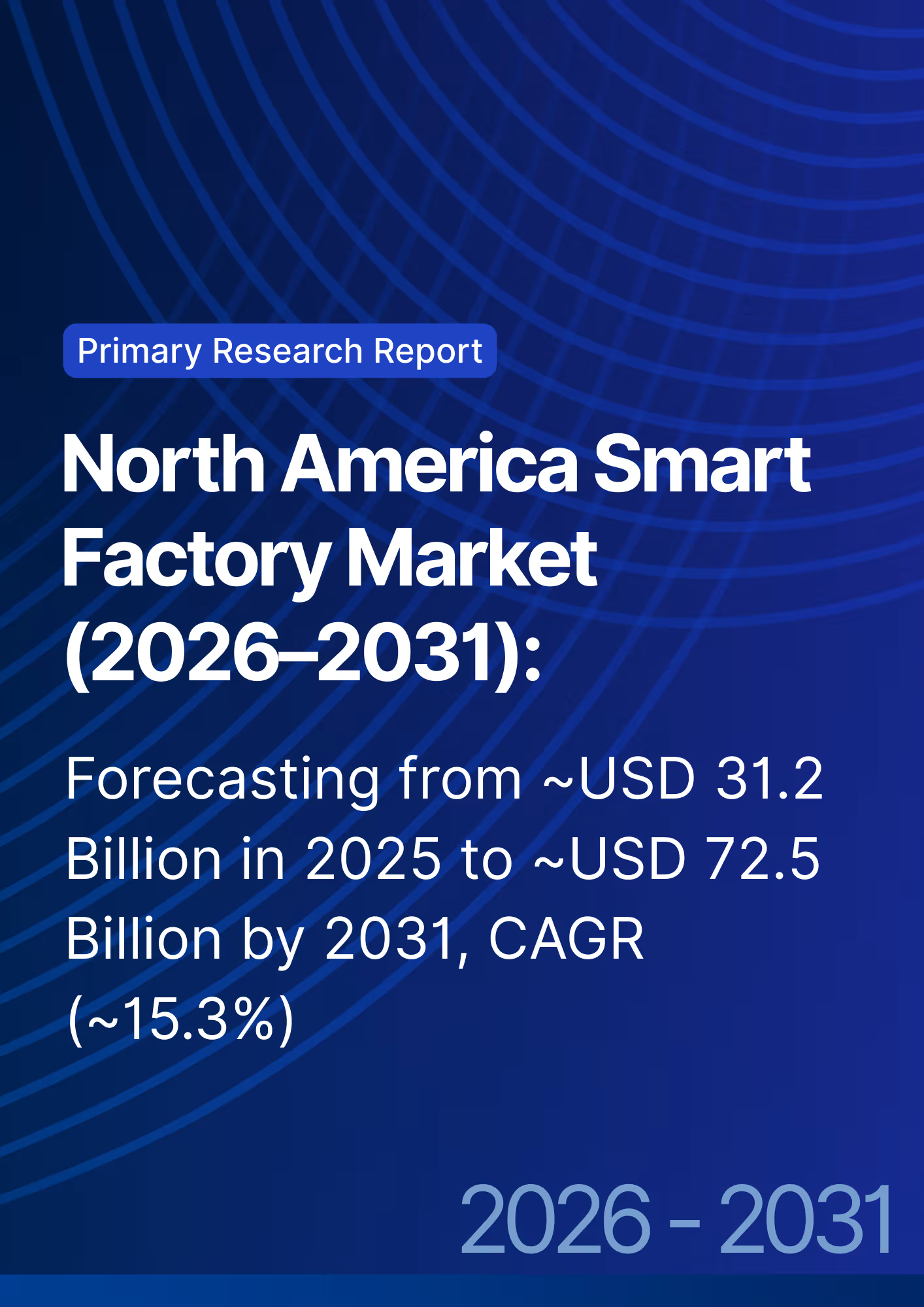
North America Smart Factory Market (2026–2031): Forecasting from ~USD 31.2 Billion in 2025 to ~USD 72.5 Billion by 2031, CAGR (~15.3%) | Industrial Sensors, Robots, 3D Printing, SCADA, MES, Industrial Safety Solutions
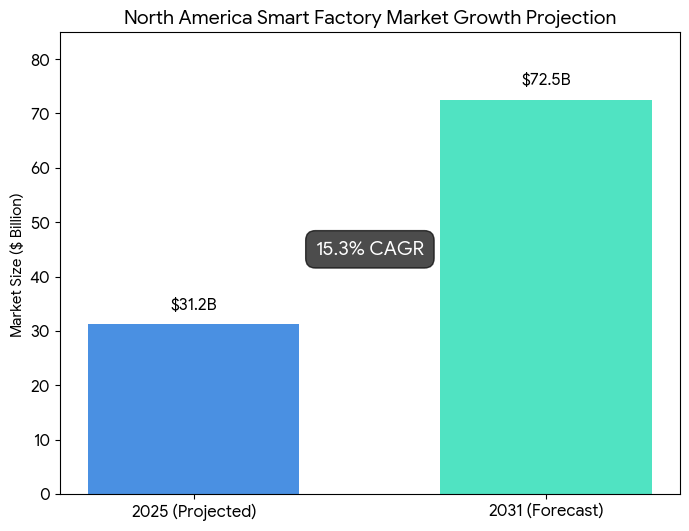
The North America smart factory market is expected to grow from USD 31.2 billion in 2025 to USD 72.5 billion by 2031, at a 15.3% CAGR. This growth is driven by the increasing adoption of advanced automation technologies like industrial sensors, robots, and 3D printing in sectors such as automotive, electronics, and pharmaceuticals. The integration of SCADA (Supervisory Control and Data Acquisition), MES (Manufacturing Execution Systems), and industrial safety solutions is enhancing operational efficiency and safety, driving smart manufacturing adoption. Additionally, the increasing demand for real-time data analytics, predictive maintenance, and energy-efficient systems is fueling the market. Governments and private enterprises are heavily investing in Industry 4.0 technologies, aiming to improve productivity, reduce downtime, and optimize the use of labor and raw materials. These developments are positioning North America as a leader in the global smart manufacturing revolution, which is expected to play a crucial role in reshaping the future of manufacturing and industrial production.
What's Covered?
Report Summary
Key Takeaways
- Market forecast: USD 31.2B (2025) to USD 72.5B (2031), 15.3% CAGR.
- Industrial sensors will account for 25% of the total market share by 2030.
- Robotics will drive 30% of market growth in the next 5 years.
- SCADA systems are set to grow by 20% CAGR, essential for real-time control.
- 3D printing technology in manufacturing is expected to reduce production costs by 15–20%.
- MES systems are projected to save up to 25% in operational costs for manufacturers.
- Automotive and electronics industries to account for 40% of total smart factory demand.
- Industrial safety solutions growing at 17% CAGR due to rising workplace safety concerns.
- AI and IoT integration increasing real-time monitoring and predictive maintenance capabilities.
- Sustainability-driven innovations contributing to green factory initiatives and energy efficiency.
Market Size & Share
The North America smart factory market is expected to expand significantly, growing from USD 31.2 billion in 2025 to USD 72.5 billion by 2031, achieving a 15.3% CAGR. Robotic systems and industrial sensors lead market growth, with robotics contributing to 30% of the total demand by 2030. SCADA systems will also see considerable growth as they are essential for real-time production control, making up 20% of market value. The rise of advanced manufacturing technologies such as 3D printing and AI-based production optimization is expected to further fuel demand. Key sectors driving this growth include automotive and electronics, which will account for 40% of total demand. Energy-efficient smart factory solutions are also gaining traction, as businesses look for ways to meet sustainability regulations and improve cost-efficiency.
Market Analysis
The North American smart factory market is rapidly evolving, with increased focus on digitization and automation. IoT-connected devices and advanced sensors enable real-time data monitoring and predictive maintenance, leading to greater operational visibility and reduced downtime. SCADA and MES platforms are integral in providing process optimization and workflow automation, while robotics systems enhance manufacturing flexibility and precision. The growing focus on sustainability, including the push for energy efficiency and low-emission factories, is driving demand for green manufacturing solutions. Furthermore, the market is also benefiting from government policies such as the Made in America Act and renewable energy subsidies. These initiatives are encouraging manufacturers to invest in next-gen automation technologies and upgrade existing infrastructure to achieve Industry 4.0 standards.
Trends & Insights
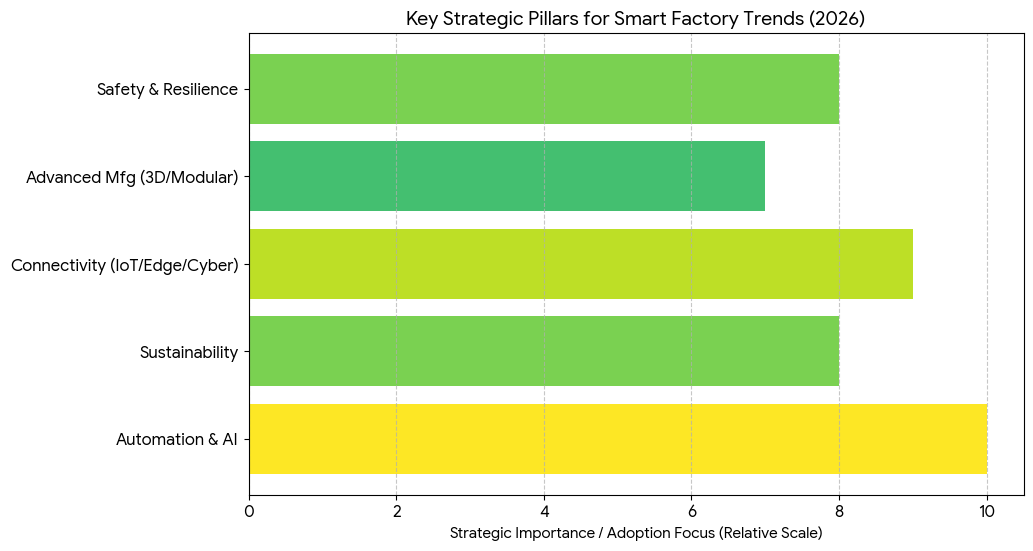
- Real-Time Monitoring: The integration of IoT-enabled sensors for predictive maintenance and remote diagnostics.
- Automation in Production: Robotics systems and AI contributing to improved productivity and reduced manual labor.
- 3D Printing Expansion: Adoption of additive manufacturing for custom production and rapid prototyping.
- AI-Driven Manufacturing: Enhancing process optimization, quality control, and decision-making.
- Sustainability Initiatives: Growing interest in green manufacturing solutions that reduce energy consumption and carbon emissions.
- Workplace Safety: The increased adoption of industrial safety solutions, including robotic safety systems and AI-based risk detection.
- Supply Chain Resilience: The rise of smart factories to enhance supply chain visibility and mitigate risks.
- Modular Factories: Increasing interest in modular and flexible manufacturing lines that can be quickly adapted.
- Cybersecurity for Smart Factories: Enhanced data protection and network security for connected manufacturing environments.
- Edge Computing: The integration of edge computing to improve real-time decision-making and reduce latency in smart factory systems.
Segment Analysis
By solution, robotic systems dominate, accounting for 30% of total market share due to their high adaptability in automotive, electronics, and warehouse operations. Industrial sensors, used for data acquisition and condition monitoring, hold 25% of the market share. SCADA and MES systems are critical for workflow automation and real-time production control, contributing 20% of the market. 3D printing is growing rapidly as additive manufacturing becomes essential for customization and rapid prototyping, representing 15% of the market. Industrial safety solutions, including AI-enabled monitoring and robotic safety devices, will also see strong growth, contributing 10% of total market value.
Geography Analysis
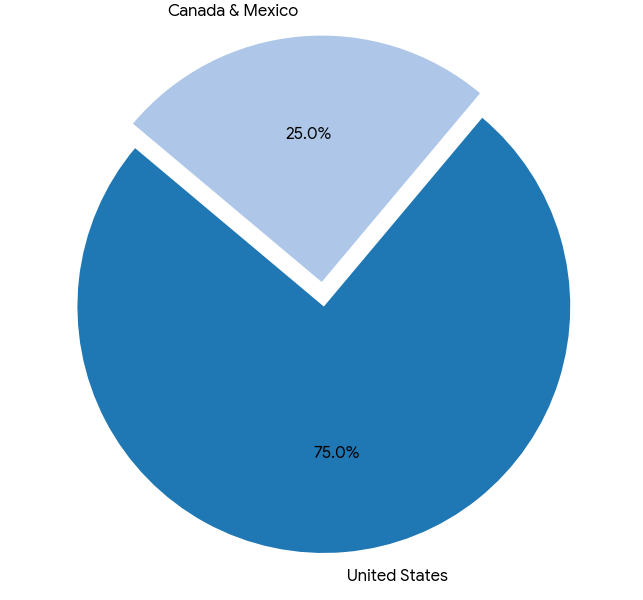
The United States leads the market, contributing over 75% of the total regional revenue. California, Texas, and Michigan are key drivers due to their dominant presence in automotive manufacturing and smart factory development. Canada is also witnessing growth in AI-driven production technologies and robotic manufacturing solutions in sectors such as aerospace, electronics, and pharmaceuticals. Mexico has become an emerging hub for smart manufacturing as U.S. companies look to leverage cost-effective labor and nearshoring strategies. Smart factory developments in smart cities and renewable energy infrastructure are also propelling growth in urban areas.
Competitive Landscape
Key players in the North American smart factory market include Siemens, Rockwell Automation, ABB, Honeywell, Schneider Electric, Fanuc, KUKA, Universal Robots, and Yaskawa Electric. Siemens and Rockwell Automation are leaders in industrial automation, providing PLC systems, SCADA, and MES solutions. ABB and KUKA dominate the robotics segment, offering collaborative robots and robotic arms for manufacturing. Honeywell is expanding its IoT-enabled smart factory solutions, while Schneider Electric focuses on energy management and sustainability. Partnerships between OEMs, cloud platforms, and manufacturers are increasing as smart factory solutions evolve to meet Industry 4.0 standards.
Report Details
Proceed To Buy
Want a More Customized Experience?
- Request a Customized Transcript: Submit your own questions or specify changes. We’ll conduct a new call with the industry expert, covering both the original and your additional questions. You’ll receive an updated report for a small fee over the standard price.
- Request a Direct Call with the Expert: If you prefer a live conversation, we can facilitate a call between you and the expert. After the call, you’ll get the full recording, a verbatim transcript, and continued platform access to query the content and more.
68 Circular Road, #02-01 049422, Singapore
Revenue Tower, Scbd, Jakarta 12190, Indonesia
4th Floor, Pinnacle Business Park, Andheri East, Mumbai, 400093
Cinnabar Hills, Embassy Golf Links Business Park, Bengaluru, Karnataka 560071
Request Custom Transcript
Related Transcripts
.avif)


68 Circular Road, #02-01 049422, Singapore
Revenue Tower, Scbd, No.52-53, Jakarta 12190, Indonesia
Cinnabar Hills, Embassy Golf Links Business Park, Bengaluru, Karnataka 560071
4th Floor, Pinnacle Business Park, Andheri East, Mumbai, 400093


68 Circular Road, #02-01 049422, Singapore
Revenue Tower, Scbd, Jakarta 12190, Indonesia
4th Floor, Pinnacle Business Park, Andheri East, Mumbai, 400093
Cinnabar Hills, Embassy Golf Links Business Park, Bengaluru, Karnataka 560071