

68 Circular Road, #02-01 049422, Singapore
Revenue Tower, Scbd, Jakarta 12190, Indonesia
4th Floor, Pinnacle Business Park, Andheri East, Mumbai, 400093
Cinnabar Hills, Embassy Golf Links Business Park, Bengaluru, Karnataka 560071


Connect With Us



68 Circular Road, #02-01 049422, Singapore
Revenue Tower, Scbd, Jakarta 12190, Indonesia
4th Floor, Pinnacle Business Park, Andheri East, Mumbai, 400093
Cinnabar Hills, Embassy Golf Links Business Park, Bengaluru, Karnataka 560071
Connect With Us
68 Circular Road, #02-01 049422, Singapore
Revenue Tower, Scbd, Jakarta 12190, Indonesia
4th Floor, Pinnacle Business Park, Andheri East, Mumbai, 400093
Cinnabar Hills, Embassy Golf Links Business Park, Bengaluru, Karnataka 560071
Request Custom Transcript
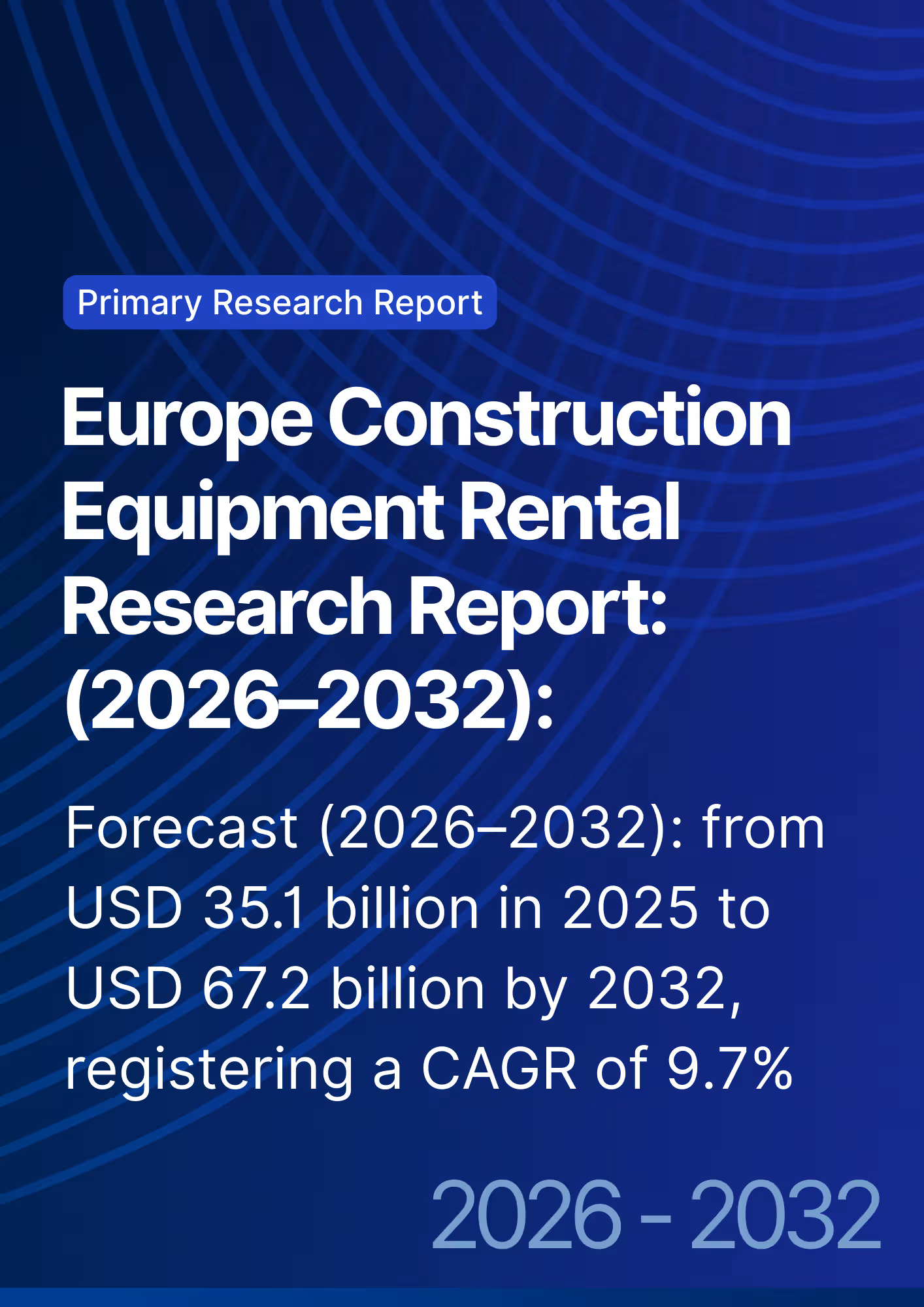
Europe Construction Equipment Rental Market Research Report: Forecast (2026–2032): from USD 35.1 billion in 2025 to USD 67.2 billion by 2032, registering a CAGR of 9.7%
The Europe construction equipment rental market is forecasted to grow significantly from USD 35.1 billion in 2025 to USD 67.2 billion by 2032, registering a CAGR of 9.7%. The market is driven by the growing trend of flexible leasing models, the rise of urban infrastructure projects, and increased demand for advanced equipment technology. Rental services are becoming a preferred choice for contractors due to cost savings, maintenance-free operations, and the ability to access newer models of heavy machinery. Strong demand for specialized equipment such as excavators, cranes, and earthmoving machinery is being supported by major construction initiatives in smart cities and transportation networks. Additionally, the shift toward zero-emission and sustainable construction solutions is prompting rental companies to incorporate eco-friendly machines into their fleets, fueling growth in the market. The increasing trend towards short-term rental agreements across industrial and commercial sectors further enhances market expansion across Europe.
What's Covered?
Report Summary
Key Takeaways
- Market projected to grow from USD 35.1B (2025) to USD 67.2B (2032), 9.7% CAGR.
- Excavators and cranes represent 45% of total market share.
- Short-term rentals (1–6 months) dominate with 55% of rental contracts.
- Sustainability trends driving demand for electric and hybrid equipment.
- Germany, France, and the UK lead with 65% of market demand.
- Technology integration (IoT, GPS) enhancing fleet management efficiency by 30%.
- Fleet management platforms enabling real-time monitoring and optimization.
- Growing demand for specialized equipment like compact excavators and backhoes.
- Flexible rental pricing models helping SMEs lower upfront equipment costs.
- EU green building regulations driving demand for eco-friendly equipment.
Market Size & Share
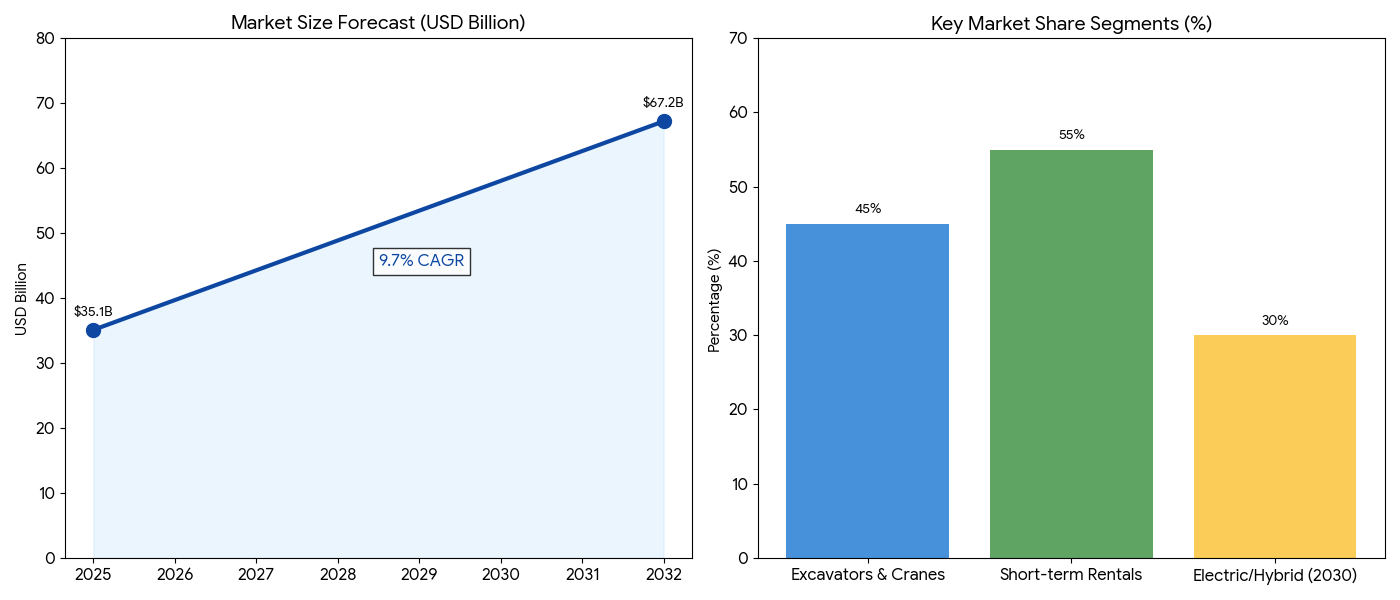
The Europe construction equipment rental market is set to grow significantly from USD 35.1 billion in 2025 to USD 67.2 billion by 2032, reflecting a 9.7% CAGR. Excavators and cranes remain the leading equipment types, together accounting for 45% of the market share due to their widespread application in large-scale construction projects. The demand for specialized equipment such as backhoes, telehandlers, and compactors is increasing as urbanization and smart city developments continue to accelerate. Short-term rental contracts (1–6 months) will account for 55% of the market share as companies look for flexible solutions for project-specific needs. The adoption of electric and hybrid equipment will grow as a result of EU regulations and increasing emphasis on sustainability, contributing an estimated 30% to the market by 2030.
Market Analysis
The market’s growth is fueled by the evolving demand for efficient, flexible equipment solutions across residential, commercial, and infrastructure projects. Automation and telematics are becoming integral to construction equipment, enhancing operational performance and reducing downtime. GPS-enabled fleet management systems allow operators to track equipment utilization, ensuring optimal performance and reducing idle time. Robust growth in green infrastructure, coupled with energy-efficient and zero-emission equipment, is positioning rental fleets as a viable, cost-effective alternative for construction companies aiming to meet environmental standards. Additionally, the growth in modular construction and prefabrication is driving demand for compact and specialized equipment that is easily adaptable and scalable.
Trends & Insights
- Urbanization driving the need for compact, noise-free equipment in city centers.
- Sustainability regulations in the EU leading to increased adoption of eco-friendly machinery.
- IoT-enabled fleet management allowing for real-time tracking and automated maintenance scheduling.
- Modular construction techniques creating new demand for specialized rental equipment.
- Subscription-based models offering low upfront cost solutions for contractors.
- AI-powered predictive analytics improving fleet management and equipment lifecycle.
- Telematics and cloud-based solutions optimizing asset tracking and jobsite monitoring.
- Growth in offshore wind and renewable energy projects stimulating demand for high-capacity cranes.
- Expansion of rental networks through online rental platforms and mobile apps.
- Shift toward fully integrated, turnkey rental solutions for large-scale construction projects.
Segment Analysis
The market is divided by equipment type and contract length. Excavators and cranes dominate, as they are central to both heavy civil and infrastructure projects. Forklifts, backhoes, and compactors are in strong demand for urban residential construction and specialized projects. The short-term rental segment is growing rapidly as construction companies increasingly prefer flexible rental periods over outright ownership, particularly for seasonal projects or temporary use equipment. Electric and hybrid equipment are expected to see significant adoption, especially among eco-conscious contractors and green building projects. By region, Germany, France, and the UK represent 65% of the market due to their heavy reliance on large-scale infrastructure and residential construction.
Geography Analysis
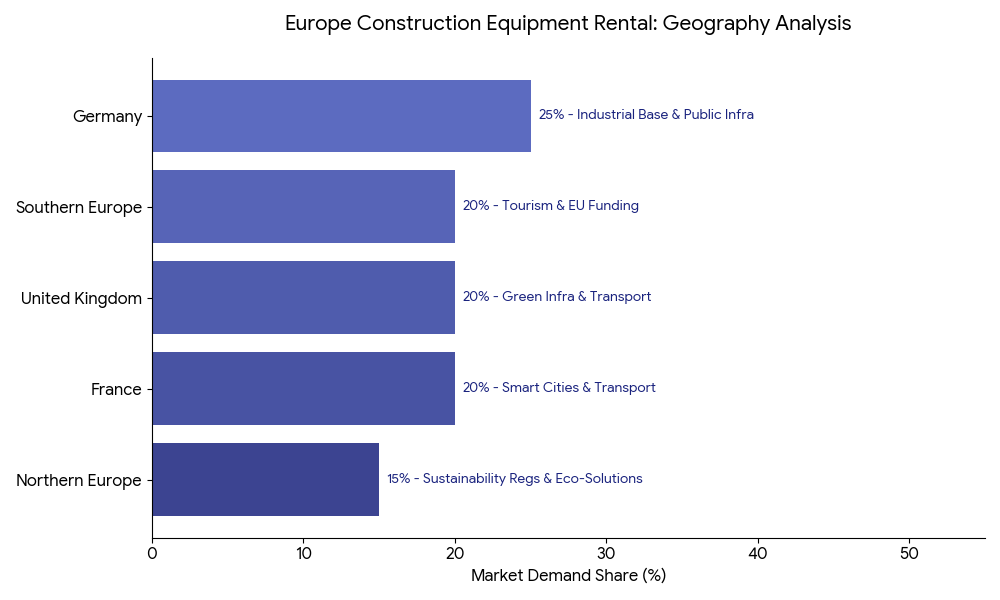
Germany leads the market with 25% of total demand, driven by its strong industrial base and public infrastructure investment. France and the UK follow, contributing 20% each as both countries experience significant growth in smart cities, green infrastructure, and transportation projects. Northern European countries, such as the Netherlands and Scandinavia, are also strong players due to their early adoption of eco-friendly construction solutions and sustainability-driven regulations. Southern Europe, including Spain and Italy, is witnessing rapid growth as construction activities in tourism and residential sectors increase, further amplified by EU funding initiatives for infrastructure development.
Competitive Landscape
Key players in the Europe construction equipment rental market include Loxam, Cramo, Ahern Rentals, United Rentals, JCB, Caterpillar, and Liebherr. Loxam and Cramo dominate in the Nordic and continental markets, with a strong presence in eco-friendly equipment and digital fleet management solutions. United Rentals is expanding its rental fleet in UK and France, while Ahern Rentals is tapping into the growth of specialized heavy-duty machinery for commercial landscaping. Manufacturers such as JCB and Caterpillar are increasingly integrating IoT connectivity and AI-enabled equipment in their rental fleets to meet growing demand. Partnerships between OEMs, rentals, and digital solutions providers are enhancing operational efficiency and customer satisfaction.
Report Details
Proceed To Buy
Want a More Customized Experience?
- Request a Customized Transcript: Submit your own questions or specify changes. We’ll conduct a new call with the industry expert, covering both the original and your additional questions. You’ll receive an updated report for a small fee over the standard price.
- Request a Direct Call with the Expert: If you prefer a live conversation, we can facilitate a call between you and the expert. After the call, you’ll get the full recording, a verbatim transcript, and continued platform access to query the content and more.
68 Circular Road, #02-01 049422, Singapore
Revenue Tower, Scbd, Jakarta 12190, Indonesia
4th Floor, Pinnacle Business Park, Andheri East, Mumbai, 400093
Cinnabar Hills, Embassy Golf Links Business Park, Bengaluru, Karnataka 560071
Request Custom Transcript
Related Transcripts
.avif)

68 Circular Road, #02-01 049422, Singapore
Revenue Tower, Scbd, No.52-53, Jakarta 12190, Indonesia
Cinnabar Hills, Embassy Golf Links Business Park, Bengaluru, Karnataka 560071
4th Floor, Pinnacle Business Park, Andheri East, Mumbai, 400093


68 Circular Road, #02-01 049422, Singapore
Revenue Tower, Scbd, Jakarta 12190, Indonesia
4th Floor, Pinnacle Business Park, Andheri East, Mumbai, 400093
Cinnabar Hills, Embassy Golf Links Business Park, Bengaluru, Karnataka 560071