

68 Circular Road, #02-01 049422, Singapore
Revenue Tower, Scbd, Jakarta 12190, Indonesia
4th Floor, Pinnacle Business Park, Andheri East, Mumbai, 400093
Cinnabar Hills, Embassy Golf Links Business Park, Bengaluru, Karnataka 560071


Connect With Us



68 Circular Road, #02-01 049422, Singapore
Revenue Tower, Scbd, Jakarta 12190, Indonesia
4th Floor, Pinnacle Business Park, Andheri East, Mumbai, 400093
Cinnabar Hills, Embassy Golf Links Business Park, Bengaluru, Karnataka 560071
Connect With Us
68 Circular Road, #02-01 049422, Singapore
Revenue Tower, Scbd, Jakarta 12190, Indonesia
4th Floor, Pinnacle Business Park, Andheri East, Mumbai, 400093
Cinnabar Hills, Embassy Golf Links Business Park, Bengaluru, Karnataka 560071
Request Custom Transcript
On-Demand Warehousing: Segmentation Analysis for US Logistics & Supply Chain
The on-demand warehousing market in the US and North America is expected to grow from $18.4B in 2025 to $52.7B by 2030 (CAGR 23.1%), driven by e-commerce growth, supply chain flexibility, and cost efficiency. The rise of cloud-based inventory management, AI-driven demand forecasting, and flexible lease models is reshaping warehousing operations. By 2030, 30% of warehousing space will be on-demand, with 40% cost savings compared to traditional lease models. The market is supported by multi-client warehouses and automated fulfillment centers, making warehousing more adaptable to fluctuating market demands.
What's Covered?
Report Summary
Key Takeaways
- Market size: $18.4B → $52.7B (CAGR 23.1%).
- 30% of warehousing space to be on-demand by 2030.
- 40% cost savings compared to traditional warehousing models.
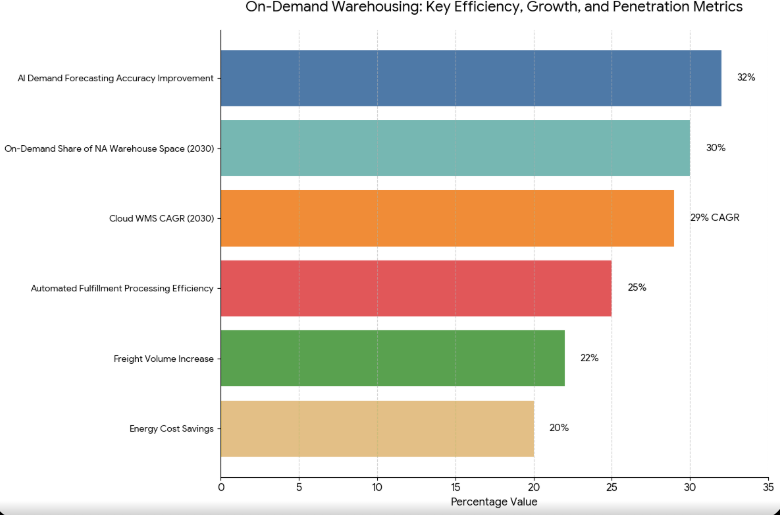
- AI-powered demand forecasting improves inventory accuracy by 32%.
- Cloud-based warehouse management systems adoption up by 29%.
- Automated fulfillment centers increase processing efficiency by 25%.
- Multi-client warehouses represent 45% of total market share.
- Real-time tracking reduces shipment delays by 18%.
- Sustainability-linked warehouse design drives 20% reduction in energy costs.
- Private sector investment surpasses $10B in 2025–2030.
Key Metrics
Market Size & Share
The on-demand warehousing market in the US and North America will expand from $18.4B in 2025 to $52.7B by 2030, with a CAGR of 23.1%. By 2030, 30% of warehousing space will be on-demand, driven by e-commerce demand, cloud-based management systems, and AI-driven inventory systems. Amazon, Walmart, and UPS are integrating multi-client warehouse models to reduce overhead costs and increase flexibility in distribution. AI-powered demand forecasting will lead to 32% more accurate inventory management, improving supply chain responsiveness. The market is also supported by the rise of automated fulfillment centers, which increase efficiency and reduce lead times by 25%. Sustainability-driven design in warehouses is projected to save 20% in energy costs by 2030, reducing the carbon footprint of supply chains. Private investment, exceeding $10B over the next five years, is funneling into infrastructure development, smart warehouse technologies, and integrated logistics platforms. By 2030, the market share of on-demand space will account for 30%, substantially reshaping North America’s logistics landscape.
Market Analysis
The growth of on-demand warehousing is propelled by increased demand for e-commerce, just-in-time inventory systems, and the need for scalable logistics. Cloud-based warehouse management systems (WMS) are expected to grow by 29% by 2030, allowing companies to scale operations dynamically in response to demand surges. AI-powered demand forecasting is central to these operations, improving inventory accuracy by 32% and allowing businesses to meet market fluctuations more efficiently. The rise of automated fulfillment centers is driving 25% more processing efficiency by reducing human error, speeding up order fulfillment, and improving supply chain velocity. AI-enhanced robotics and IoT tracking systems are enabling real-time inventory updates, reducing shipment delays by 18%. Sustainability is a key trend, with 20% energy cost savings expected through green building standards and renewable energy use. By 2030, the North American market will have nearly 30% of warehouse space operating under on-demand models, with freight volumes increasing by 22% due to better space utilization and flexibility.
Trends & Insights
- AI in Demand Forecasting: Inventory accuracy to improve by 32%.
- Multi-Client Warehouses: Account for 45% of the market share.
- Automation Growth: 25% increase in fulfillment efficiency by 2030.
- Sustainability Integration: 20% reduction in energy costs for on-demand spaces.
- Cloud-WMS Adoption: 29% growth in real-time inventory management solutions.
- Dynamic Freight Scaling: 22% increase in freight volumes through on-demand flexibility.
- E-Commerce Shift: 30% of space dedicated to on-demand logistics by 2030.
- Green Warehousing: Energy-efficient designs lead to 20% savings.
- Inventory Visibility: Real-time IoT tracking reduces 18% delays in fulfillment.
- Sustainability Financing: $10B+ invested in smart warehousing infrastructure.
These trends underscore how on-demand warehousing and AI-driven automation are reshaping North American supply chains, increasing efficiency, reducing operational costs, and driving sustainability.
Segment Analysis
The on-demand warehousing market is segmented into cloud-based systems (40%), automated fulfillment (25%), AI-powered inventory solutions (20%), and green warehousing (15%). Cloud-based WMS accounts for 40% of the market, with Amazon Web Services (AWS) and SAP dominating the space. Automated fulfillment systems are expanding, with robotics and AI technologies growing by 25% annually. AI-powered inventory management plays a pivotal role in improving supply chain visibility, particularly in retail and e-commerce sectors. Green warehousing, encompassing sustainable energy systems and recycled building materials, is set to grow by 20% by 2030. Freight logistics companies, such as FedEx and UPS, are implementing on-demand warehousing to meet the surging demand for e-commerce delivery. The total space dedicated to on-demand operations will reach 30% of the total market share by 2030, driven by digitalization, automation, and sustainability efforts in warehousing.
Geography Analysis
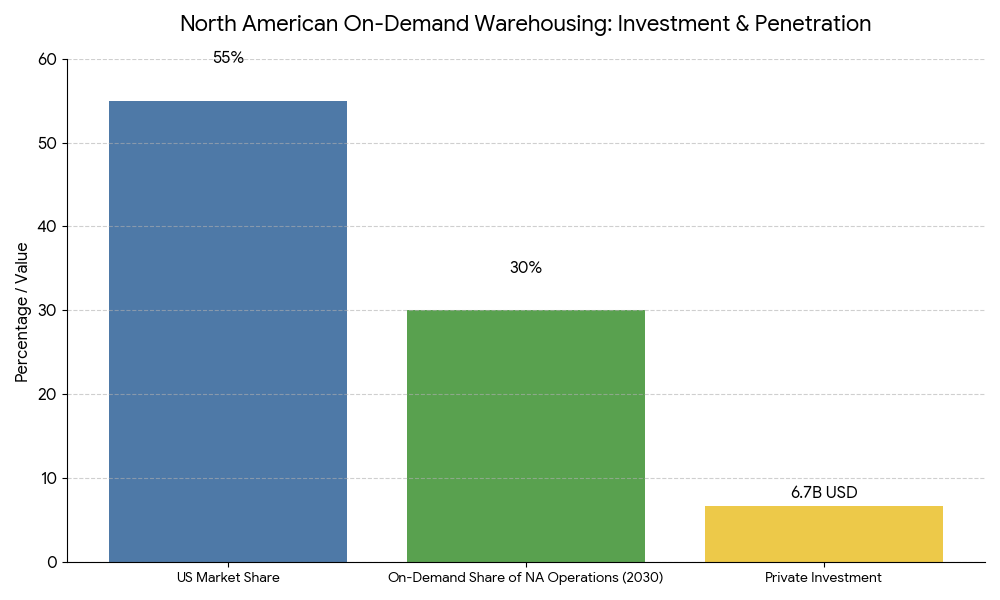
The US holds 55% of the North American on-demand warehousing market, with cities like New York, Chicago, and Los Angeles leading in warehouse automation and AI-enhanced logistics. Canada contributes 25% of the market, with a focus on automated inventory management and cloud-based systems. Mexico and Central America are also emerging players, with 10% market share in cross-border logistics driven by US e-commerce growth. By 2030, North American logistics will see 30% of warehousing operations shift to on-demand models, with $6.7B in private investments driving technological integration and AI-powered optimization.
Competitive Landscape
Key players include DHL Supply Chain, XPO Logistics, Kuehne+Nagel, Prologis, and Ceva Logistics, collectively managing over 50% of the on-demand warehousing market. AI and IoT solutions from companies like Oracle and SAP are integral to inventory management and order fulfillment. Technology firms like Zebra Technologies and GreyOrange are advancing robotics-based automation and real-time tracking. Amazon, Walmart, and Target are heavily investing in automated fulfillment and cloud-WMS to streamline supply chains. Startups, such as Locus and ShipBob, are emerging as key players in last-mile delivery and scalable warehousing models. Competitive advantage in this market will be driven by cost-efficiency, speed, and technology-driven optimization in the warehouse and logistics sector.
Report Details
Proceed To Buy
Want a More Customized Experience?
- Request a Customized Transcript: Submit your own questions or specify changes. We’ll conduct a new call with the industry expert, covering both the original and your additional questions. You’ll receive an updated report for a small fee over the standard price.
- Request a Direct Call with the Expert: If you prefer a live conversation, we can facilitate a call between you and the expert. After the call, you’ll get the full recording, a verbatim transcript, and continued platform access to query the content and more.
68 Circular Road, #02-01 049422, Singapore
Revenue Tower, Scbd, Jakarta 12190, Indonesia
4th Floor, Pinnacle Business Park, Andheri East, Mumbai, 400093
Cinnabar Hills, Embassy Golf Links Business Park, Bengaluru, Karnataka 560071
Request Custom Transcript
Related Transcripts

$ 1350



68 Circular Road, #02-01 049422, Singapore
Revenue Tower, Scbd, No.52-53, Jakarta 12190, Indonesia
Cinnabar Hills, Embassy Golf Links Business Park, Bengaluru, Karnataka 560071
4th Floor, Pinnacle Business Park, Andheri East, Mumbai, 400093


68 Circular Road, #02-01 049422, Singapore
Revenue Tower, Scbd, Jakarta 12190, Indonesia
4th Floor, Pinnacle Business Park, Andheri East, Mumbai, 400093
Cinnabar Hills, Embassy Golf Links Business Park, Bengaluru, Karnataka 560071