The Shift from One-Off Calls to Scalable Expert Intelligence
The research edge is shifting from one-off expert calls to scalable expert intelligence searchable transcripts, tagged operator insights, and decision-ready summaries your team can reuse across due diligence, GTM strategy, and product planning.
For a long time, expert calls have been treated like a “quick unlock.” You schedule a call, ask the questions that matter, take notes, pull a few quotes, and move forward with more confidence than you had yesterday. In many cases, that’s exactly what you neede especially when the market is noisy, secondary research is generic, and the real truth sits inside operator experience.
But the problem isn’t the expert call. The problem is the one-off nature of how most teams use it.
Because in most organizations, the value of an expert call peaks during the conversation and then drops fast. The notes live in a private doc. The recording gets buried. The insights don’t translate cleanly into the next IC memo, the next GTM sprint, or the next board deck. And a few weeks later, a different teammate asks the same question again… and the cycle repeats.
That’s why the smartest strategy, investment, product, and GTM teams are making a visible shift: from one-off calls to scalable expert intelligence where operator conversations become structured, searchable, and reusable assets instead of single-use moments.
The hidden cost of one-off expert calls
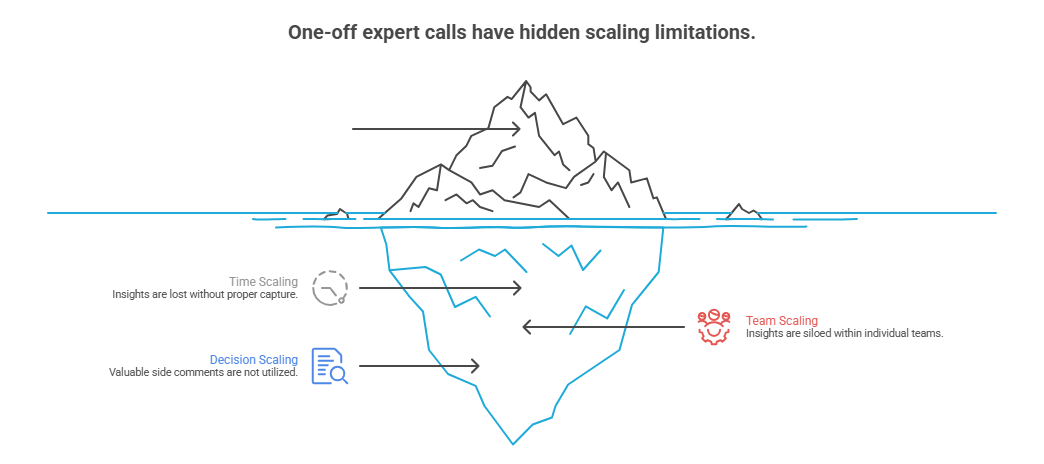
A single expert call can be incredibly valuable. It can validate a market entry thesis, reveal a buyer objection that kills a pricing model, or expose the real competitive dynamic that nobody writes about publicly. But one-off calls break down when teams try to scale decision-making across multiple stakeholders and timelines.
First, they don’t scale across time. A call you did in January might contain the exact insight you need in April. But unless it’s captured cleanly, tagged properly, and easy to retrieve, it’s effectively gone. Organizations end up paying for the same learning multiple times not because the insight wasn’t found, but because it wasn’t reusable.
Second, they don’t scale across teams. Product, strategy, and GTM teams often investigate overlapping questions: what buyers value, where adoption stalls, what pricing feels fair, and why competitors win deals. If insights are locked in one person’s notes, cross-functional alignment becomes slow, political, and dependent on who “remembers” the best.
Third, they don’t scale across decisions. Most calls answer a specific question, but the conversation usually contains more signal than what you asked for. The side comments about implementation friction, procurement timing, internal blockers, and second-order competitor responses are often the most valuable pieces. If those aren’t captured and structured, they never make it into the decisions that matter.
In short: one-off calls create insight, but they rarely create an intelligence system.
What changed: why scalable intelligence is becoming the default
This shift isn’t happening because teams suddenly care more about documentation. It’s happening because the speed and complexity of decision-making has increased and the old research workflow can’t keep up.
1) Decision cycles are shorter, but stakes are higher. In investing, diligence windows compress. In GTM, competitors copy faster and channels shift quickly. In product, feature bets compound into years of roadmap consequences. Teams need real-time clarity, not retrospective explanations.
2) Secondary research is abundant but often blunt. There’s more information than ever, but not necessarily more truth. Analyst reports can be broad and slow. Blog posts can be opinionated. Public data can lag reality. Operator insight fills the gap because it brings context that secondary sources can’t: what actually happens inside workflows, purchasing decisions, deployments, and renewals.
3) Teams now expect research to be “searchable.” The modern expectation is simple: if the insight exists in your organization, you should be able to find it quickly. That’s why intelligence is moving toward searchable transcripts, tagged themes, and Q&A-style retrieval so strategy work becomes faster without becoming shallow.
What “scalable expert intelligence” actually means
Scalable expert intelligence isn’t “doing more calls.” It’s building a workflow where each call becomes a durable research asset that can be reused across projects, stakeholders, and time.
At its core, scalable intelligence has four qualities:
1) It’s captured cleanly. Not messy notes, not half-remembered quotes clean transcripts that preserve the full context of what was said. When you can go back to the source, you reduce misinterpretation and increase confidence.
2) It’s structured for decision-use. Raw conversations are valuable, but structure is what makes them usable. The best intelligence outputs don’t just record what was said they shape it into decision-ready elements such as summaries, key takeaways, market maps, competitor matrices, and KPI-level observations.
3) It’s retrievable. Scalability comes from retrieval. If your team can search by theme, KPI, company, segment, or even a specific quote, then every future project starts with a knowledge base instead of a blank page.
4) It compounds over time. This is the real unlock. When insights are reusable, each new call doesn’t just answer a question it strengthens your overall understanding of a market. Over months, you build a library of operator truth that improves every subsequent thesis, memo, and strategy decision.
The practical shift: from “call outcomes” to “intelligence assets”
Most teams measure expert calls by outcomes: Did we get the answers? Did the expert sound credible? Did we extract 2–3 usable quotes?
Scalable teams measure calls differently. They ask:
Did we capture the call in a form that others can use?
Did we tag it so it can be retrieved later?
Did we convert it into a summary that can travel across stakeholders?
Did it strengthen our internal knowledge base so the next project starts ahead?
This is where expert intelligence becomes a system. The call is no longer the deliverable. The call is the input. The deliverable is the structured intelligence you can reuse.
How Transcript IQ is built for scalable expert intelligence
Transcript IQ’s positioning is built around a straightforward workflow: turning operator conversations into structured intelligence that teams can actually use quickly, repeatedly, and across decisions.
Operator POVs, not opinions
The foundation is operator-led conversations guided for depth and data so the output is grounded in real operating context rather than generic commentary.
Analyst-engineered outputs
Instead of shipping raw call dumps, outputs are reviewed, annotated, and distilled into decision-ready formats. This directly addresses the biggest pain point with one-off calls: the gap between “interesting conversation” and “usable strategy input.”
A searchable knowledge base (where intelligence becomes reusable)
Transcript IQ is designed so teams can search by theme, KPI, or quote and use natural-language Q&A to pull out the exact insight they need without rereading everything. This is the mechanics of scalability: retrieval replaces rework.
And importantly, the deliverables are explicit: transcripts, human-written summaries, tagging by theme/company/geography, and an AI assistant to query the content so the intelligence stays usable beyond the first reader.
Where scalable expert intelligence drives the most impact
Once you move from one-off calls to reusable intelligence, the benefit shows up everywhere strategy is made.
Investment due diligence and IC memos become sharper because you’re not relying on single anecdotes. You can compare multiple operator perspectives, trace patterns, and pull specific proof points into a thesis without starting from scratch each time.
Go-to-market strategy becomes faster because you can pull real buyer objections, sales-cycle realities, and pricing friction points directly from past transcripts then validate only what’s new, instead of re-learning what’s already true.
Product planning becomes more grounded because feature decisions can reference what operators and customers consistently describe as pain, workflow friction, and adoption blockers rather than internal assumptions or loud anecdotal feedback.
And across all of these, the biggest advantage is alignment: when teams work from the same searchable source of truth, decision-making gets faster and cleaner.
Final word: the future isn’t more calls it’s reusable intelligence
One-off calls will always matter. Sometimes you need a precise answer right now from the right operator at the right time.
But the future belongs to teams that treat expert conversations as a scalable intelligence asset captured cleanly, structured for decisions, searchable for reuse, and built to compound over time.
That’s the shift: from isolated insights to an intelligence engine.
Request a Custom Transcript Tailored to Your Decision Needs
If you’re validating a market, pressure-testing a thesis, building GTM strategy, or running diligence, Transcript IQ can turn expert conversations into decision-ready intelligence with clean transcripts, human-written summaries, and searchable, tagged insights your team can reuse across projects.
Request a Custom Transcript Tailored to Your Decision Needs
Looking for clarity on a specific market, strategy, or challenge? Let us turn high-value expert conversations into actionable intelligence—just for you. Submit your request and we’ll deliver a decision-ready report that cuts through noise and accelerates execution.
Thank you! Your submission has been received!
Oops! Something went wrong while submitting the form.