Pressure-test any investment, GTM, or product thesis in 72 hours by turning assumptions into killer questions and validating them with operator-led primary research, searchable expert transcripts, and decision-ready insights.
If you’ve ever written a crisp investment thesis, GTM thesis, or product thesis… you already know the scary part isn’t writing it.
It’s believing it.
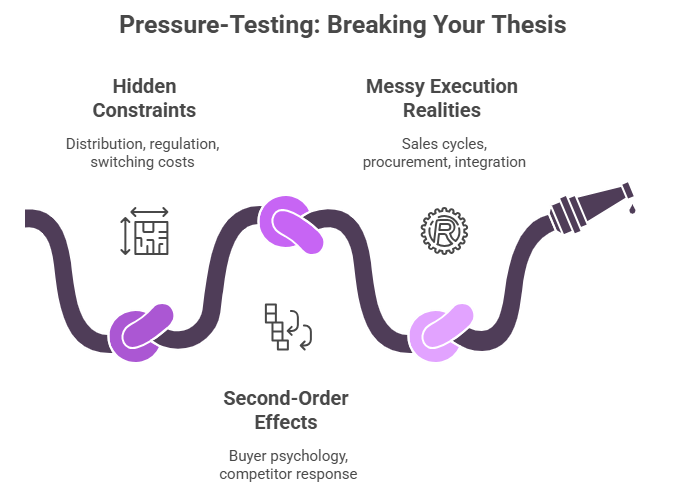
Because most theses are built on clean logic and messy reality. They look airtight in an IC memo or strategy deck until you hit the market and discover one uncomfortable truth:
Your thesis isn’t wrong. Your assumptions are untested.
In high-velocity environments (venture capital, private equity, corporate strategy, product, growth), the fastest teams don’t “research more.” They pressure-test faster using primary research, operator insight, and competitive intelligence that exposes weak assumptions early, before time and capital get committed.
This post breaks down the fastest way to pressure-test a thesis using a repeatable, operator-led workflow powered by searchable expert transcripts, modular insights, and analyst-engineered summaries.
What “pressure-testing” actually means (and why most teams do it too late)
Pressure-testing is not “validating your idea.” It’s harsher than that.
Pressure-testing = actively trying to break your thesis.
“We can actually win in this market with this wedge, this pricing, and this GTM motion.”
This is why operator-led primary intelligence matters. Real operators don’t talk in frameworks. They talk in constraints, trade-offs, and “here’s what actually happens on the ground.”
The fastest framework: a 72-hour Thesis Pressure-Test Sprint
Here’s a simple truth:
Your thesis only needs 5–7 assumptions to be dangerous.
So instead of weeks of broad desk research, run a focused sprint designed for speed and signal.
Day 1: Write the thesis as assumptions (not story)
Take your thesis and force it into a set of assumptions that can be proven or broken.
Use this structure:
Market reality assumption “This problem is urgent and budgeted.”
Buyer behavior assumption “The buyer is X and decides based on Y.”
GTM assumption “We can acquire customers through Z channel at acceptable CAC.”
Pricing / packaging assumption “The market will pay ₹/$ ___ for this value.”
Competitive assumption “Competitors won’t crush us / we have a defendable wedge.”
Execution assumption “We can deliver outcomes without massive implementation friction.”
Keep it tight. If you can’t articulate the assumptions, you can’t test them.
Day 2: Convert assumptions into “Killer Questions”
Pressure-testing isn’t about asking a lot of questions.
It’s about asking the right questions the ones that can kill the thesis fast.
Examples:
“What makes buyers delay purchasing even when the pain is real?”
“Where does this fail in procurement, compliance, or integration?”
“What does a competitor do the moment this gains traction?”
“What does ‘good enough’ look like and who already delivers it?”
“What causes churn after the first 90 days?”
Day 3: Run operator-led validation and triangulate
This is where most teams waste time. They gather random signals (tweets, blogs, outdated reports) and confuse volume for truth.
Instead, pressure-test using primary research operator conversations and expert interviews then make it reusable through cleaned transcripts, executive summaries, tagging, and search.
Why expert transcripts beat “more research” for thesis validation
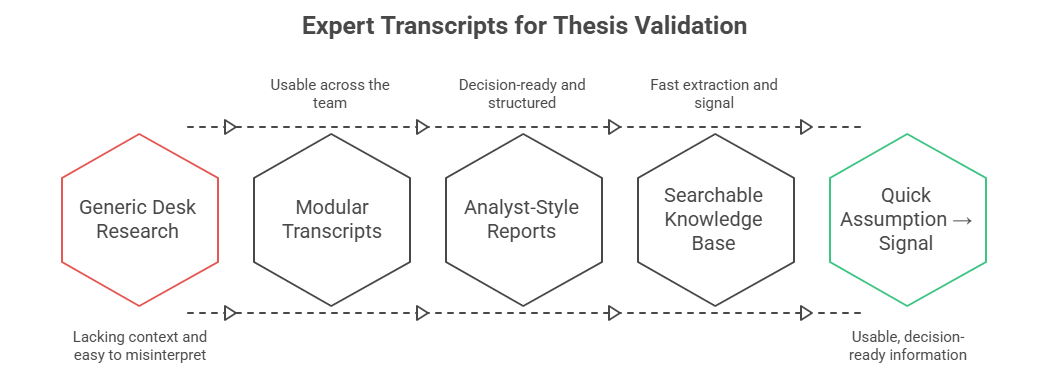
Desk research is useful but it’s often:
generic (written for everyone)
lagging (based on historical data)
easy to misinterpret (no real-world context)
Operator conversations fix that, especially when the output is usable across the team not trapped inside one person’s notes.
Transcript IQ is built around exactly this idea: turning high-impact expert conversations into modular transcripts, analyst-style reports, and a searchable knowledge base so teams can move from assumption → signal quickly.
And crucially: it’s not just “a transcript.” Each report is structured to be decision-ready:
cleaned and readable expert transcript
human-written executive summary
tags by theme / company / geography / use case
strategic framing (what it means, not just what was said)
AI-assisted Q&A within the report for fast extraction
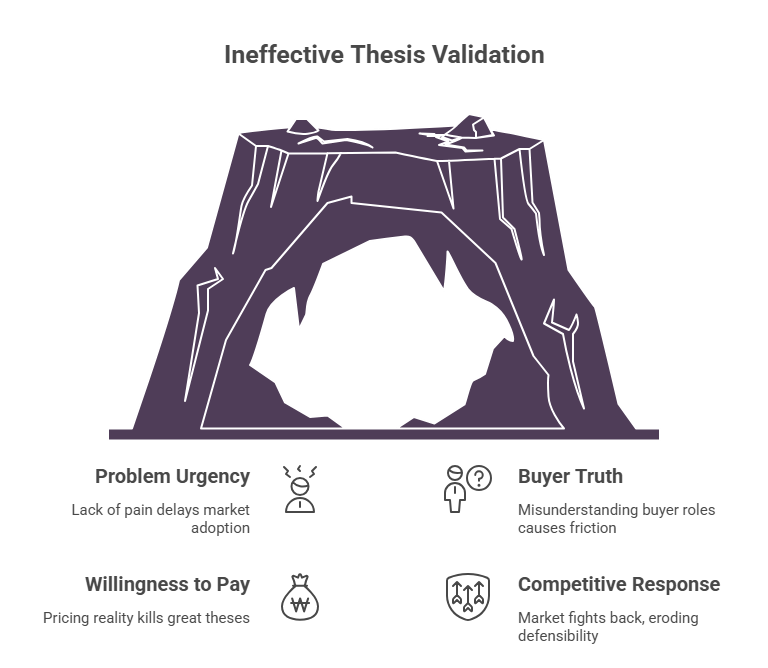
The Pressure-Test Stack: 4 signals you need (or you’re guessing)
When teams say “We pressure-tested the thesis,” what they usually mean is:
“We found some supportive evidence.”
That’s not pressure-testing. Real pressure-testing looks for disconfirming signals.
Here are the 4 signals that matter most:
1) Problem urgency (is it painful enough to act?)
Most markets have problems. Few have problems people pay to solve right now.
Pressure-test by extracting:
what triggers urgency
what delays urgency
what budgets it comes from (and what it competes with)
2) Buyer truth (who decides, who blocks, who influences?)
This is where thesis decks get fantasy-prone.
Operator insight quickly clarifies:
the real buyer vs the user
procurement and compliance friction
internal politics and switching costs
3) Willingness to pay (pricing reality, not pricing theory)
Great theses die at pricing.
Pressure-test by pulling:
price anchors buyers already use
how ROI is evaluated in the real world
what packaging makes sense (and what feels like a tax)
4) Competitive response (how the market fights back)
Competitors don’t sit still. They bundle, undercut, copy, or block distribution.
Pressure-test by mapping:
who already “solves enough”
where incumbents have unfair advantage
what wedge actually stays defensible
A practical example: Pressure-testing an expansion thesis in under a week
Imagine a growth team has this thesis:
“We can expand into Mid-Market because our product reduces operational cost by automating X.”
Looks reasonable. But pressure-testing reveals the actual questions:
Do mid-market buyers feel this cost as painful? Or is it “accepted overhead”?
Is automation even the value driver, or is reporting/compliance the real hook?
Does the mid-market buy via self-serve, channel partners, or a sales-led model?
Who blocks? IT? Finance? Procurement? A legacy vendor?
What “good enough” tools already exist inside their stack?
A fast pressure-test approach:
Run 3–5 operator conversations across target segments (users + decision-makers).
Capture the calls into searchable, modular transcripts.
Extract “deal-breaker” insights into an executive summary.
Turn output into a one-page decision memo: Proceed / Pivot / Pause.
That’s how a thesis goes from “sounds right” to “survives contact with reality.”
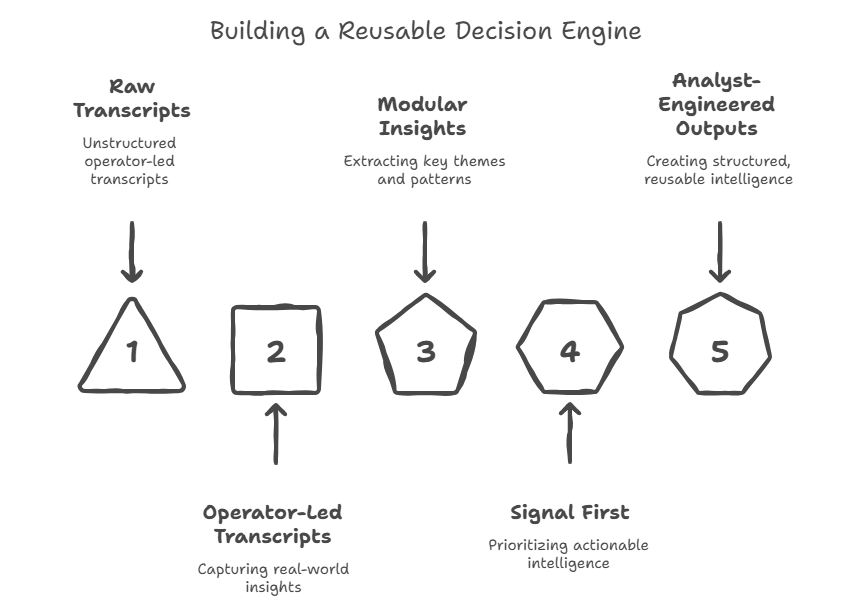
The real payoff: pressure-testing creates a reusable decision engine
The underrated benefit of doing this well is not just better decisions today.
It’s compounding advantage.
When your team builds a library of operator-led transcripts and modular insights, you stop re-learning the same lessons every quarter. You can:
search by KPI, theme, quote, competitor, or buyer segment
reuse intelligence across diligence, GTM, product planning, and board prep
align stakeholders fast because everyone sees the same ground truth
This is why Transcript IQ emphasizes “signal first” and “analyst-engineered outputs” not just raw content.
Final word: The fastest way to pressure-test a thesis is to try to break it with operator truth
If you want speed, don’t widen the research.
Sharpen the test.
Turn the thesis into assumptions. Write killer questions. Get operator-led primary intelligence. Make it searchable and reusable so your team can move from assumption → signal → decision in days, not months.
Request a Custom Transcript for Your Thesis Pressure-Test
If you’re validating an investment thesis, go-to-market strategy, market entry, or product wedge, Transcript IQ can turn high-impact expert conversations into decision-ready research assets clean transcripts, executive summaries, and modular insights your team can actually use.
Want to pressure-test a specific thesis? Start with a custom brief and we’ll build a focused transcript pack around your key assumptions.
Request a Custom Transcript Tailored to Your Decision Needs
Looking for clarity on a specific market, strategy, or challenge? Let us turn high-value expert conversations into actionable intelligence—just for you. Submit your request and we’ll deliver a decision-ready report that cuts through noise and accelerates execution.
Thank you! Your submission has been received!
Oops! Something went wrong while submitting the form.