From Blank Slide to Board Deck: Where Research Actually Starts
Research doesn’t start with a Google search it starts with the decision. Learn how top strategy and investment teams move from a blank slide to a board-ready deck using primary research, expert transcripts, and reusable intelligence
Most decks don’t fail because the slides are ugly. They fail because the logic is built on weak ground truth.
You’ve seen it: a team spends days polishing a board deck, tightening the narrative, and perfecting the charts only to get hit with the same questions in the meeting. “How do we know?” “What’s the source?” “Is this true in this segment?” “What did operators actually say?” That moment isn’t a design problem. It’s a research problem.
And the uncomfortable truth is this: research rarely starts where people think it starts. It doesn’t begin with a Google query, a PDF report, or a market sizing model. Research starts earlier when you define the decision you’re trying to make and the assumptions you’re willing to bet on.
This blog breaks down where research actually starts, why most teams start too late, and how to move from a blank slide to a board deck with decision-grade confidence using a workflow built on primary research, operator insights, and searchable expert transcripts.
The myth: “Research starts with data”
When people say “let’s start with research,” what they often mean is “let’s start collecting information.” That feels productive. It creates momentum. It fills the blank slide with something anything.
But collecting information without clarity creates a predictable failure mode:
you gather too much
you summarize too broadly
you confuse volume with validation
you build a narrative first, then cherry-pick evidence to support it
Board decks don’t reward information. They reward decision clarity.
That’s why the best teams start research with a different question:
What decision will this deck support specifically?
Because every board deck is really a decision document in disguise. It’s a request for approval, budget, alignment, or belief. And research exists to reduce risk around that ask.
If you don’t define the decision first, your research becomes “interesting” instead of “useful.”
Where research actually starts: the Decision Thesis
Before you search for anything, you need a one-line thesis that answers:
What are we trying to prove, choose, or commit to?
Examples:
“We should enter mid-market with a sales-led motion.”
“We should acquire this asset and expand into Southeast Asia.”
“We should raise prices by 15% and reposition around outcomes.”
“We should deprecate Feature X and double down on Workflow Y.”
This isn’t the final narrative. It’s the starting anchor.
From there, you convert the thesis into assumptions because assumptions are testable. Stories are not.
A practical way to do this is to break your decision thesis into 5–7 assumptions:
Market reality: Is the pain urgent and budgeted?
Buyer behavior: Who buys and what triggers a yes?
Willingness to pay: What pricing actually clears the market?
GTM feasibility: Can we reach buyers efficiently?
Competitive dynamics: Who blocks us and how do they respond?
Execution risk: What breaks in implementation or adoption?
Outcome proof: What metric will validate success?
Now research has a job: pressure-test these assumptions.
This is where research truly starts not at the data layer, but at the assumption layer.
The fastest path from blank slide to insight: “Killer Questions”
Once assumptions are defined, the next step is to write questions designed to break them.
Not questions like:
“What is the market size?”
“What are the trends?”
But questions like:
“What makes buyers delay even when the pain is real?”
“What does procurement kill deals over?”
“What’s the most common reason pilots don’t convert?”
“What would a competitor do if we price like this?”
“What does ‘good enough’ already look like in the current stack?”
“What do operators wish vendors understood before selling them?”
These are killer questions because the answers can kill weak theses fast, which is exactly what you want before a board meeting.
A board deck is not the place to discover the thesis breaks. Research is where you discover that early, privately, and quickly.
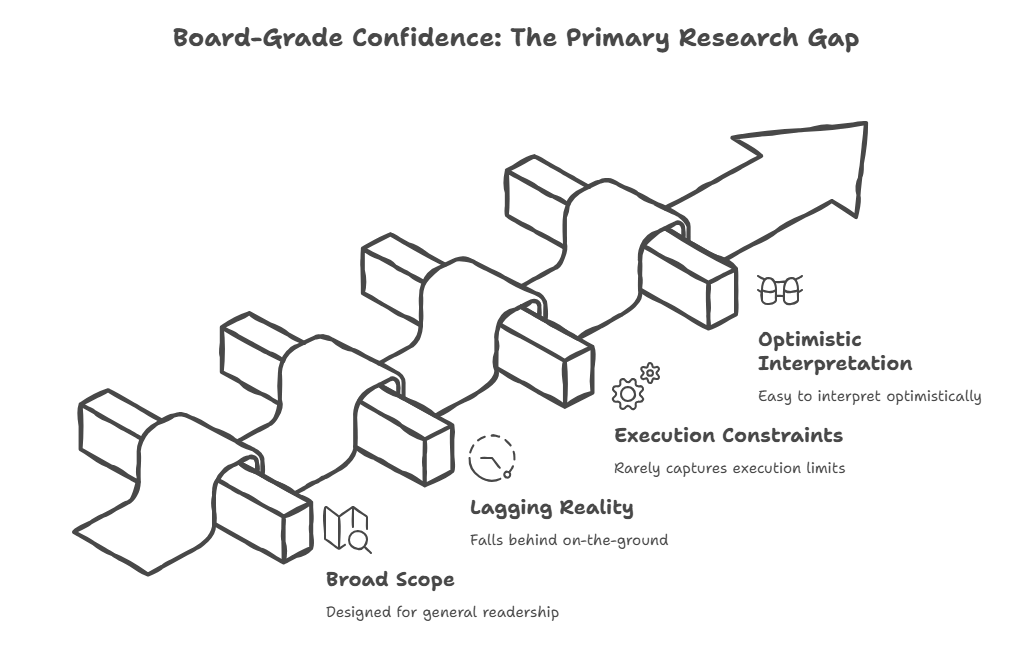
Why primary research is the backbone of board-grade confidence
Most board discussions aren’t about whether your slides are coherent. They’re about whether your claims are real.
That’s why secondary research alone often falls short:
it’s broad, designed for general readership
it lags on-the-ground reality
it rarely captures execution constraints
it’s easy to interpret optimistically
Primary research especially operator insight does the opposite. It surfaces:
the friction people don’t publish
the internal decision dynamics
the “hidden no’s” behind buyer behavior
the practical reality of adoption, churn, and switching
If secondary research tells you what should be true, primary research tells you what is true.
And when you’re building a board deck, “is true” matters more than “sounds true.”
The missing link: capturing operator insight in a reusable way
Here’s where most teams lose speed: they do the operator calls, but they don’t build a system around them.
So the same insights get rediscovered repeatedly:
someone does three calls for pricing
another person does three calls for GTM
a third person does calls for competition …and none of it becomes a reusable asset.
That’s why scalable teams treat operator insight as something you can store and retrieve, not just “use once.”
This is where searchable expert transcripts change the workflow.
When conversations are converted into clean transcripts, structured summaries, and tagged themes, you can:
pull proof points quickly
triangulate perspectives across experts
reuse learnings across multiple decks
reduce reliance on one person’s notes
accelerate future board prep dramatically
Instead of “we spoke to a few people,” you can confidently say: “Across multiple operator perspectives, here are the consistent patterns and here’s where the market disagrees.”
That’s board-grade research.
The Board Deck Research Stack: a practical workflow
Let’s make it concrete. Here’s a workflow that consistently gets teams from blank slide to board deck without chaos.
1) Start with the slide titles (before the slide content)
A powerful trick: write the deck as a list of slide titles first.
For example:
“Why now: the shift creating urgency”
“What buyers are actually optimizing for”
“Competitive landscape: who wins and why”
“Unit economics: what breaks, what scales”
“GTM plan: motion, funnel, and constraints”
“Risks: what could invalidate the plan”
“Decision ask: what we need approval for”
These titles become your research agenda.
If you can’t name the slide, you can’t research the slide.
2) Map each slide to evidence types
Not all slides need the same evidence.
“Why now” might rely on macro signals + operator confirmation
“Most failures happen at implementation because ____.”
“The wedge that actually wins is ____.”
In other words: specificity, patterns, and constraints.
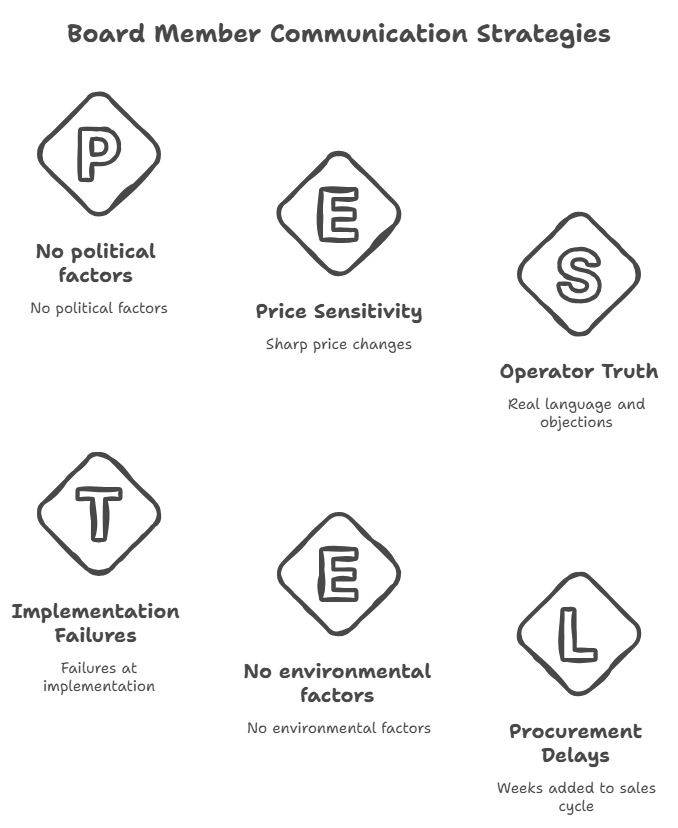
This is why transcripts and primary insights are so powerful: they provide the raw material for specificity. They give you real language, real objections, real benchmarks.
And when you can reference operator truth, your deck stops sounding like a pitch and starts sounding like a plan.
The real insight: research is not a phase it’s an engine
The best organizations don’t “do research” per deck. They build an intelligence engine that compounds.
Over time, this creates an unfair advantage:
you start every new deck with a head start
you reduce repeated work across teams
you build a library of validated assumptions
you move faster without lowering quality
That’s the shift: from ad-hoc research to scalable expert intelligence.
And it’s exactly why turning operator conversations into searchable, reusable assets is becoming core to modern strategy and investment workflows.
Conclusion: The deck starts with the decision, not the slide
A blank slide feels like the beginning. But it isn’t.
The true beginning is the decision you’re trying to make and the assumptions that could break it.
When research starts there, everything gets cleaner:
questions get sharper
calls get more valuable
evidence becomes relevant
narratives become credible
board discussions become faster and less opinion-driven
The fastest path from blank slide to board deck isn’t “more data.”
It’s better validation, built on operator truth, structured capture, and reusable intelligence.
Request a Custom Transcript for Your Next Deck
If you’re building an IC memo, board deck, market entry plan, or GTM strategy, Transcript IQ can help you convert expert conversations into decision-ready intelligence clean transcripts, executive summaries, and searchable insights you can reuse across projects.
Request a Custom Transcript Tailored to Your Decision Needs
Looking for clarity on a specific market, strategy, or challenge? Let us turn high-value expert conversations into actionable intelligence—just for you. Submit your request and we’ll deliver a decision-ready report that cuts through noise and accelerates execution.
Thank you! Your submission has been received!
Oops! Something went wrong while submitting the form.