
The Direct Answer: What an Expert Call Transcript Is
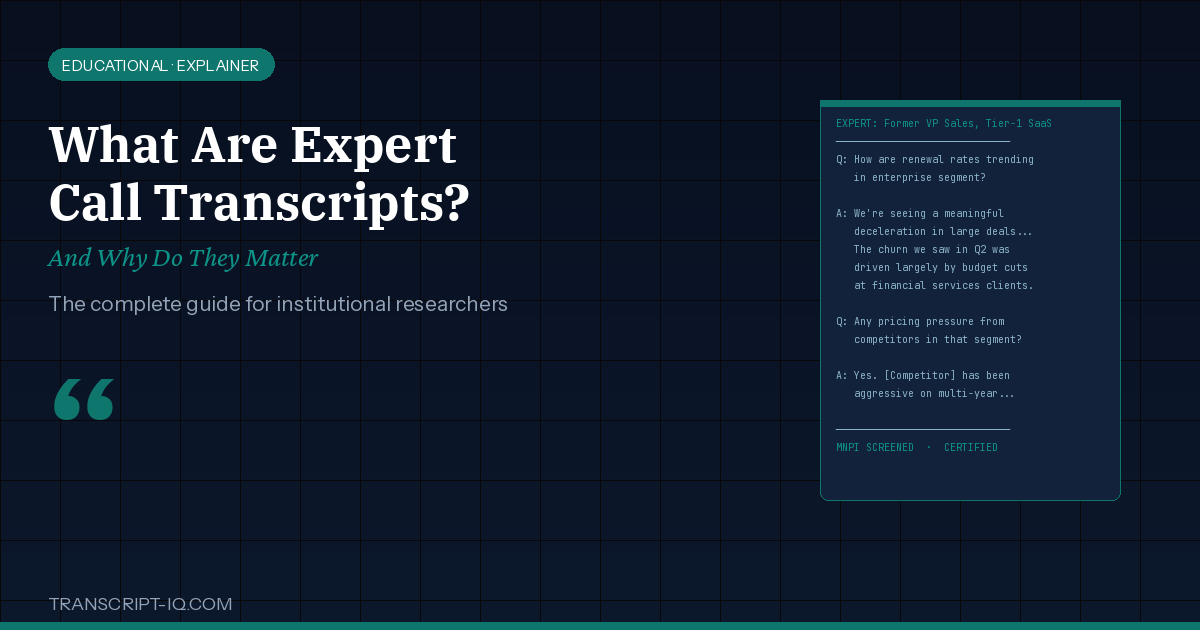
An expert call transcript is a verbatim written record of a structured conversation between an institutional researcher and an industry practitioner. The practitioner is typically a former executive, a senior operating professional, or a sector specialist who held a decision-making role at a relevant company. The conversation is facilitated through an expert network, and the resulting document captures not just the answers but the full exchange, including the questions that produced them.
These transcripts have been among the most closely guarded research assets in institutional finance for over two decades. Until now, accessing them required either a six figure annual subscription to a platform like Tegus or Third Bridge, or the budget and internal bandwidth to commission fresh calls through networks like GLG, AlphaSights, or Guidepoint. There was no retail market. There was no per document access. Transcripts existed behind walled gardens, accessible only to the largest and most capitalised research operations on the planet.
Transcript IQ is the first retail marketplace for institutional quality, MNPI screened expert call transcripts. It is structured so that an analyst at a boutique fund, a consultant at a growing advisory firm, or a research team at a mid market organisation can purchase exactly the transcript they need, when they need it, without committing to a platform subscription they cannot fully utilise. That context matters for understanding why these documents carry the value they do.
What Does an Expert Call Transcript Contain
The document structure of a professionally produced expert call transcript is consistent across reputable providers. Understanding each component helps researchers assess what they are buying and how to extract maximum value from it.
The Expert Profile
Every transcript opens with an anonymised description of the expert who participated in the call. At Transcript IQ, this follows the format: Former [Title], [Company Type]. For example: Former VP of Product Strategy, Tier 1 Semiconductor Manufacturer. The specific name and employer are withheld to protect identity and comply with confidentiality obligations, but the role, seniority level, and institutional context are always disclosed clearly.
This matters because the credibility of information in the transcript is directly tied to the vantage point of the source. A former CFO discussing capital allocation priorities carries different evidentiary weight than a former analyst at the same organisation covering the same period. Researchers assess source quality before investing time in the full content.
The Executive Summary
A well structured transcript includes a two to three paragraph executive summary at the front, written immediately after the call. This summary captures the three to five most significant insights from the conversation in plain language, making it possible to assess relevance in under two minutes before committing to a full read.
Every transcript in the Transcript IQ library carries a moderator written executive summary alongside a compliance certification date and methodology statement. This is standard practice; the compliance layer is not a footnote but a core component of the document.
The Verbatim Body
The core of the document is the full verbatim record of the conversation, formatted as a dialogue between the moderator and the expert. This is not a paraphrased summary or a set of bullet points. It is the actual words spoken, preserved in sequence, including the questions that elicited each response.
This matters for a reason that is frequently underappreciated: the question structure in a high quality expert call is as informative as the answers. An experienced researcher asking about gross margin dynamics in a software business is implicitly signalling what they believe the key variables to be. Reading both the questions and the answers gives a researcher not just the information but the analytical framework within which it was extracted.
Company and Sector Tags
Institutional grade transcripts are tagged with the companies and sectors discussed during the call. These tags serve two purposes: enabling discovery so that a researcher can find the right transcript for a given diligence question, and informing the compliance review by ensuring that companies referenced have been checked against restricted lists and that no material non public information has been inadvertently captured.
Why Expert Call Transcripts Have the Value They Do
To understand why research teams pay hundreds of dollars for a single document, it helps to understand what it is replacing and what it makes possible.
The Information That Does Not Appear in Public Sources
Public market research has one fundamental limitation: it is, by definition, public. Sell side equity research, management earnings transcripts, investor presentations, and news coverage are all available to every market participant simultaneously. They are a shared starting point, not an information advantage.
Expert call transcripts capture the practitioner layer of knowledge that sits between public information and regulated insider information. A former VP of Sales at a target company knows things about the sales cycle, customer retention patterns, pricing strategy, and go to market efficiency that are not available anywhere in the public domain, but that also do not constitute material non public information in the regulatory sense. This is the zone where professional research teams build their analytical edge, and expert call transcripts are the primary mechanism for capturing it in a structured, reviewable, and retainable format.
Speed and Availability at the Point of Need
The traditional alternative to buying a transcript is commissioning a fresh expert call. The problem is that commissioning takes time: typically three to seven business days from brief submission to call completion, even with a well resourced network. In deal diligence, earnings season preparation, or fast moving sector analysis, that timeline is frequently incompatible with the research need.
A transcript purchased from a library is available immediately. The researcher can be reading within minutes of identifying the need. For teams working to compressed timelines, this immediacy has direct economic value that is independent of the content quality.
Structured and Auditable Research Infrastructure
Unlike a phone call or a set of handwritten notes, a transcript is a structured document. It can be shared with colleagues, cited in an investment committee presentation, retained in a document management system for audit purposes, and re read months later when a new angle on the same thesis emerges.
This structural quality makes transcripts far more durable than the conversations they capture. The information survives the moment of transmission and becomes part of the permanent research record of the team that acquired it.
What MNPI Screening Means and Why It Matters for Retail Access
Every transcript listed on Transcript IQ has been reviewed for material non public information before being made available for purchase. This is not a formality. It is the compliance foundation that makes the retail model possible in the first place.
Material non public information is information that a reasonable investor would consider significant for an investment decision and that has not been disclosed through public channels. Expert call transcripts, if not properly screened, carry the risk of inadvertently capturing this type of information: forward looking revenue guidance, details of pending transactions, or unreleased product information, for example.
The Transcript IQ review process checks each document against a compliance framework before publication, generates a certification document that records the screening date and methodology, and anonymises all expert identifying information. When a research team purchases a transcript, they can present the compliance certificate to their internal compliance function with confidence that the document has been through an institutional quality review.
This is what separates a properly produced expert call transcript from a podcast recording, a LinkedIn post by a former executive, or a paraphrased industry interview. The compliance infrastructure is built into the document, not added as an afterthought.
Who Uses Expert Call Transcripts
The user base is broader than most people assume, and it is growing as the retail marketplace model makes access genuinely democratic for the first time.
Private Equity and Venture Capital Research Teams
PE and VC firms use expert call transcripts primarily in the diligence phase of a new investment. The typical workflow involves purchasing two to four transcripts at the start of a process, using the insights to sharpen the diligence hypothesis, and then commissioning one or two custom calls on the specific questions that remain unanswered. This hybrid approach, combining library access with bespoke commissioning, consistently produces better research at lower total cost than running every primary research question as a fresh call.
Equity Analysts at Hedge Funds
Hedge fund analysts covering a broad universe of names use transcript libraries to maintain what amounts to a permanent channel check programme. Rather than scheduling fresh calls before each earnings season, they keep a small library of relevant transcripts for their core positions and refresh it quarterly. The per transcript cost model makes this economical even for smaller funds that cannot justify an enterprise subscription.
Management Consultants and Strategy Teams
Consulting teams use expert call transcripts in the research phase of strategy engagements. The advantage over commissioned calls in this context is that transcripts can be purchased, reviewed, and assessed for relevance before a client engagement formally begins, allowing the team to arrive at the kickoff already informed about the sector's practitioner knowledge layer.
Corporate Strategy and Mergers and Acquisitions Teams
In house strategy and M and A teams at large corporates increasingly use expert call transcripts as a complement to their own market intelligence. The external practitioner perspective captured in a well sourced transcript often contains information about competitive dynamics, pricing trends, or talent movements that is simply not visible from inside the organisation.
Transcript IQ: Why This Is the First Platform Built for Retail Access
For more than a decade, the expert call transcript market was organised around institutional subscriptions priced for the largest research operations in the world. A seat on a platform like Tegus or Third Bridge started at approximately fifteen thousand dollars per year. Access to GLG or AlphaSights required an annual platform fee before a single call could be scheduled. There was no access point for the analyst at a boutique fund, the partner at a regional advisory, or the researcher at a corporate strategy team with an episodic rather than continuous research need.
Transcript IQ launched as the first platform to offer individual expert call transcripts for purchase without any subscription, platform fee, or minimum commitment. The pricing structure is transparent: Standard transcripts at three hundred and forty nine dollars for Director level, Premium at four hundred and forty nine dollars for VP level, and Elite at five hundred and ninety nine dollars for C suite. You purchase the document. You own it. You receive a PDF. There is no platform lock in and no ongoing obligation beyond the transaction.
Every transcript in the library has been sourced and moderated by the Nextyn expert network, MNPI screened, and compliance certified before publication. The library covers technology, healthcare, financial services, consumer, industrials, and nine additional sectors, with new content added on an ongoing basis.
For teams that cannot find what they need in the existing library, Transcript IQ also offers custom commissioning through the same Nextyn network: a bespoke call sourced, moderated, transcribed, and certified, delivered within five to seven business days from brief submission.
The retail model is not a downgrade of the institutional model. It is the institutional model made available at the unit level, without the infrastructure overhead that most research teams cannot justify.
Frequently Asked Questions About Expert Call Transcripts
Are expert call transcripts legal to use for investment research?
Yes, when sourced from a reputable provider that conducts proper MNPI screening. The legal framework for expert network research is well established in the United States and the United Kingdom. The key compliance requirement is that the research process does not result in the transmission of material non public information. Transcript IQ screens every document before publication and provides a compliance certificate, making it straightforward to integrate into existing institutional compliance workflows.
How is an expert call transcript different from an earnings call transcript?
An earnings call transcript records the formal quarterly investor call between company management and public market participants. An expert call transcript records a private research conversation with a former or current industry practitioner, typically someone with direct operational experience at a company or in a sector. Earnings transcripts contain what management chooses to disclose publicly. Expert call transcripts contain what a practitioner knows from direct experience, including information that investor relations materials are specifically designed not to surface.
How long does it take to read an expert call transcript?
A standard forty five to sixty minute expert call produces a transcript of approximately eight thousand to twelve thousand words. At a comfortable reading pace, this takes thirty to forty minutes. Most institutional researchers use a two pass approach: a fast first read to assess relevance and locate the key passages, followed by a slower annotated second read focused on the specific evidence most relevant to their current thesis question.
Can a transcript purchased from Transcript IQ be used in an investment committee presentation?
Yes. Each transcript comes with a compliance certification document. The recommended citation format for institutional use is: Expert call, [Sector], via Transcript IQ, [Date of purchase]. This format provides sufficient attribution for audit trails while protecting expert anonymity. Both the transcript and its certification can be retained in your document management system as part of the permanent research record.
What makes Transcript IQ different from Tegus, Third Bridge, or AlphaSights?
Tegus and Third Bridge are subscription platforms with annual fees that typically start at fifteen thousand dollars per user per year, designed for teams that read thirty or more transcripts per month. AlphaSights and GLG are expert networks that charge per call plus an annual platform fee. Transcript IQ is structured differently: there is no subscription, no platform fee, and no minimum purchase. You buy the exact document you need and pay only for that. If your team reads fewer than twenty five transcripts per year, the per document model will almost always produce significantly better economics than a subscription platform. If you need research that does not exist in the library, the custom commissioning option delivers at a comparable price point to a single call on a traditional expert network.